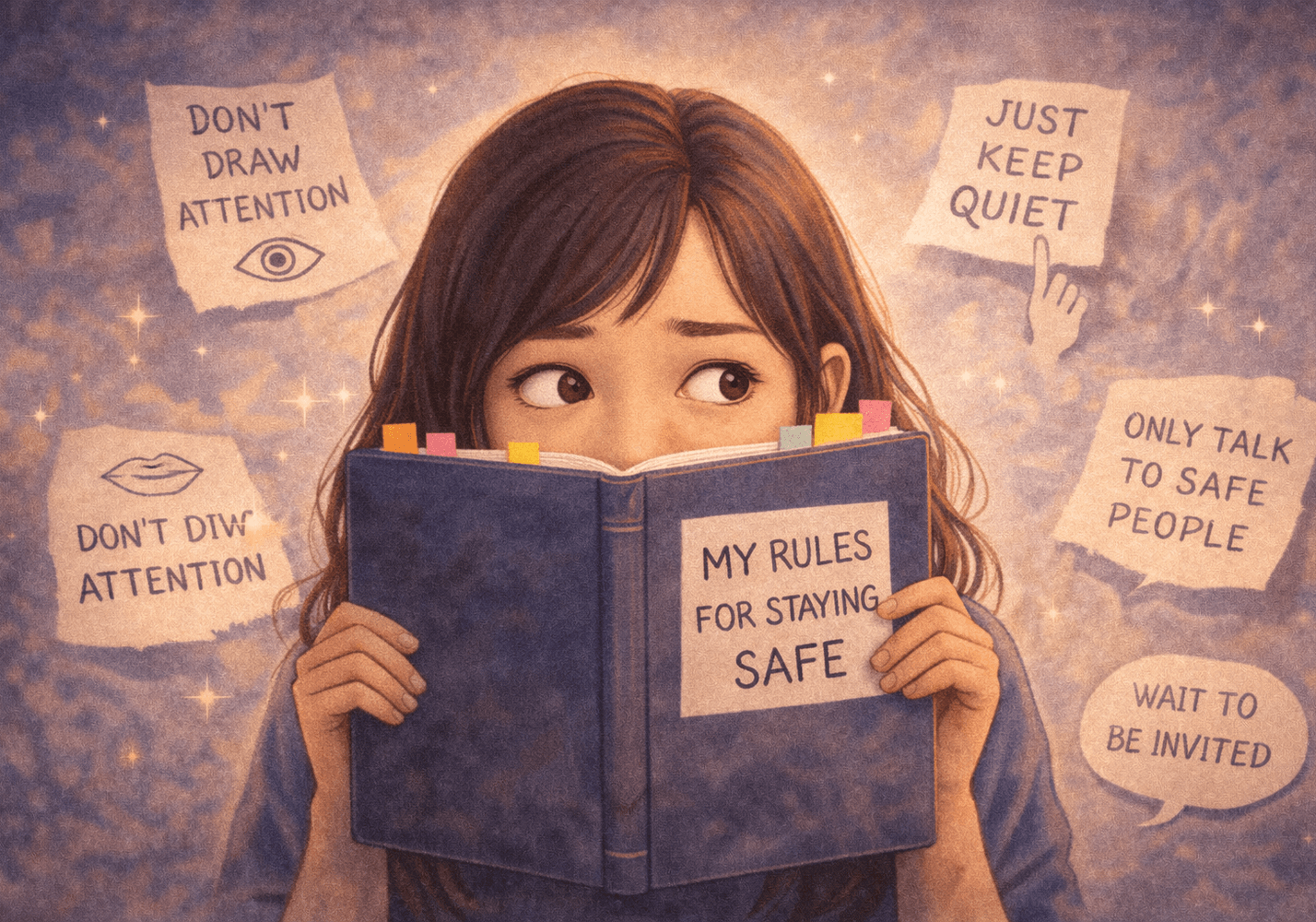
Shyness isn’t fear itself. It’s what we built around fear.
At some point—often without realizing it—we begin creating rules to protect ourselves. Rules about when it’s okay to speak. About who it’s safe to approach. About how visible we should allow ourselves to be. These rules don’t arrive as a list or a conscious decision. They form quietly, shaped by moments of embarrassment, rejection, confusion, or overwhelm. Each rule is an attempt to reduce risk, to limit exposure, to keep us from getting hurt again.
At first, these rules serve a purpose. They help us navigate situations that feel unpredictable or unsafe. If speaking up once led to ridicule, a rule forms: Better to stay quiet. If being seen drew attention we weren’t ready for, another rule follows: Don’t stand out. Over time, these small adjustments begin to stack. What started as protection slowly becomes habit.
Eventually, we stop noticing the rules altogether.
They feel like personality. Like preference. Like “just the way I am.” We tell ourselves we’re not the kind of person who speaks in meetings, approaches strangers, or takes up space. We mistake our protective strategies for fixed traits, forgetting that they were shaped in response to specific moments—many of them long past.
The trouble isn’t that we created rules. The trouble is that we rarely revisit them.
As life changes, the situations that once required protection often fade. We grow older, more capable, more resilient. Yet the rules remain in place, quietly governing our behavior. What once kept us safe begins to limit us instead. The external danger may be gone, but the internal boundaries stay firm.
This is how shyness becomes self-enforcing. The world no longer needs to tell us to be careful—we do it for ourselves.
And because these rules were created to keep us safe, questioning them can feel risky. Breaking a rule doesn’t feel like growth; it feels like danger. Even when the stakes are low, the body remembers why the rule existed in the first place. So we hesitate. We hold back. We stay within the familiar edges of what feels allowed.
But here’s the quiet truth: rules created for survival aren’t always suited for growth.
Recognizing this doesn’t mean rejecting your shyness or forcing yourself to act against your nature. It means becoming curious about the rules you’re living by. Asking where they came from. Asking whether they still serve you. Asking what might be possible if one or two of them were gently loosened.
Shyness isn’t the enemy. It’s evidence that you once needed protection—and found a way to provide it for yourself. The goal isn’t to tear down those defenses all at once. It’s to notice them, understand them, and decide—consciously this time—which ones you still need.
Because safety built on outdated rules isn’t safety anymore.
It’s confinement.
And the moment you realize that some of your limits were self-imposed—not because you were weak, but because you were careful—is the moment you begin to choose something new.